


The EUDAMED 2026 deadline is no longer something to plan around – it is something to act on now. For manufacturers of medical devices and IVDs operating in the EU, the May 28 deadline marks the point at which full EUDAMED obligations become enforceable across all relevant modules. With the final days before EUDAMED now in view, the window for unhurried preparation has closed.
This article covers what still needs to happen, where the most common gaps appear, and how to move through the last days of EUDAMED deadline pressure without costly errors.
What the 28 May 2026 Date Actually Enforces
The mandatory date of EUDAMED in 2026 brings full enforceability to obligations that have been phased in over the preceding years. This is not a new system going live – it is an existing system for which the grace period ends.
With the EUDAMED notice published on 27 November 2025, the European database becomes officially mandatory. While the database has six modules, the four following modules are now declared functional:
- ACT/Actor module
- UDI/Device module
- Notified Bodies and Certificates
- Market Surveillance module
Organisations that still have gaps in any of these areas are not dealing with a paperwork issue – they are dealing with a market access risk.
For organisations still working through last minute EUDAMED compliance steps, the most important thing to understand is that enforcement applies in all Member States. National competent authorities use EUDAMED as their primary reference for compliance checks, and a device without a complete and accurate registration has no reliable regulatory standing.
What Still Needs to Happen in the Last Days
Most organizations at this stage have gaps in at least one of four areas: actor registration, device and UDI data, or QMS alignment.
- Actor registration – Your SRN (Single Registration Number) needs to be active and verified, and your legal entity details need to match what your national authority has on file. For non-EU manufacturers, your Authorised Representative (EAR) also needs to be correctly linked in EUDAMED – not just named in your paperwork. If that link is missing or wrong, the regulatory standing of your devices can be called into question.
- Device and UDI data – Your UDI-DI entries need to be registered and a mandate should confirm that your documentation matches what’s in EUDAMED.
- Worth a specific mention here: The EMDN is the EU-specific nomenclature required under MDR/IVDR, and if the code has to match your CE certificate scope and should not be too broad.
- QMS alignment – Your Quality Management System needs to have clear ownership of EUDAMED data maintenance built into it: not just the initial registration, but ongoing updates, incident reporting, and field safety notices. Treating EUDAMED as a one-time setup task rather than a standing QMS obligation is a pattern that shows up repeatedly in post-deadline audit findings.
IVDR Has Its Own Pressure Points
Many IVDs that sat in a lower risk category under the old IVD Directive have moved up under IVDR Annex VIII rules, bringing notified body involvement into scope for the first time.
Performance evaluation documentation for IVDs also needs to align with EUDAMED device records.The European Commission’s medical devices regulation overview covers transition timelines by device class in full, and it is worth checking your devices against it if there is any uncertainty about where they sit.
A Quick Checklist for the Final Stretch
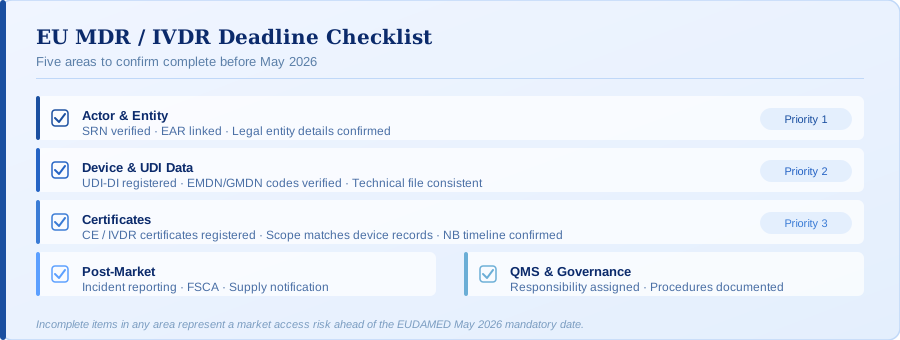
If you want a single reference for the EU MDR IVDR deadline checklist at 60 days out, these are the areas to confirm:
Actor and entity: SRN active and verified, EAR appointed and correctly linked for non-EU manufacturers, legal entity details consistent with national authority records.
Device and UDI: Basic UDI-DI and UDI-DI registered, EMDN codes verified, device classification reviewed, technical file consistent with EUDAMED records.
Certificates: MRR or IVDR certificates registered and linked in EUDAMED, certificate scope matching device records.
Post-market: Incident and FSCA reporting pathways established, supply notification obligations confirmed where applicable.
QMS and governance: Internal responsibility for EUDAMED maintenance assigned, data accuracy reviewed, procedures documented.If any of these are incomplete, the final days of the EUDAMED deadline call for targeted action, not further planning.
Getting Ready with Obelis
Obelis handles the full range of what the EUDAMED 28 May 2026 deadline countdown demands – from EUDAMED Registration support across actor, device, modules, to Authorised Representative (EAR) services for non-EU manufacturers, Technical File Review, CE Marking Guidance, and Quality Management System Support aligned with ongoing EUDAMED maintenance.
If the legal side needs attention, Legal Services covering EAR contracts and GDPR considerations are part of the offer too. For organisations that need a broader strategic review, Consultancy for Medical Devices covers the full picture.
Reaching the team is straightforward – schedule a call directly on the Obelis website and the conversation starts from where you actually are.
FAQs
EMDN codes are mandatory and validated against certificates. Errors-like mismatched codes, wrong specificity, or misalignment with CE scope-lead to registration failures or inconsistencies flagged by authorities.
Only compliant devices can be registered in the UDI-DI modules. This implies that only devices with a valid certificate can be registered, when applicable (e.g., certain class I devices do not require a notified body’s certificate).
The EUDAMED requirements apply to all economic operators involved in placing medical devices on the EU market. This includes manufacturers who design and produce devices, importers bringing products into the EU, authorised representatives acting on behalf of non-EU manufacturers, and, in certain cases, distributors who may have indirect obligations depending on their role in the supply chain.